
It’s 6:42 p.m. The pasta water is boiling, the sauce needs stirring, and the wooden spoon has vanished. It’s somewhere under a pizza cutter, three loose batteries and a takeout menu from 2019. The water boils over. Dinner becomes a rescue mission.
Good kitchen drawer organization prevents that scene. You don’t need a renovation or a color-coded spreadsheet. You need a clear layout, inserts that fit and about two hours. This guide covers kitchen drawer organization ideas for every drawer in the room, fixes for deep drawers, IKEA options with Canadian sizes and prices, and a cleaning-supply setup that keeps bottles upright.
Why Most Drawers Fail (It’s Rarely the Drawer)
Open any chaotic drawer and the pattern is the same. Too many items, no assigned spots, and a few things nobody has touched since the last move. A tray won’t fix that.
Before buying anything, drawers often need an honest evaluation and a good declutter more than extra organizers. A utensil drawer is the classic example: the contents just need thinning, and the problem disappears.
Three habits separate tidy drawers from messy ones:
- Every item has a home. A divider gives each tool a fixed spot, which removes the daily guessing game.
- Zones follow the cook. Items live where they get used, not where they happened to land.
- Edits happen regularly. A quick seasonal check keeps the drawer from drifting back.
Step Zero: Empty, Sort, Measure
Set aside 90 minutes and a clear counter. Then work in this order:
- Empty one drawer at a time. Emptying the whole kitchen at once creates a bigger mess than you started with.
- Sort into four piles: keep here, move elsewhere, donate, toss. Be strict. If five spatulas compete for one slot, three leave.
- Wipe the inside. A drawer you cleaned out is a drawer you’ll want to keep clean.
- Measure the interior. Record width, depth and height, in both centimetres and inches if you’ll be shopping across stores. A tray that’s 5 mm too wide won’t fit, however pretty it looks online.
Keep the measurements in your phone’s notes app. Future you, standing in a store aisle, will be grateful.
Kitchen Drawer Layout: Put Things Where You Use Them
A good kitchen drawer layout follows your movements, not a catalogue photo. KraftMaid recommends storing items in the drawer nearest the place you’ll use them, such as a coffee-pod organizer beside the coffee maker and mugs. One design source gives a simple map:
- Near the stove: pots, pans and cooking utensils, so prep flows smoothly
- Next to the dishwasher: dishes and silverware, for fast unloading
- Under an island: larger items and overflow pantry goods
- Beside the pantry: heavy or oversized dry goods
Two placement rules save the most effort. Put your heaviest items, like cast iron, in the lowest drawers. And keep daily-use items at the front of each drawer. IKEA’s advice is the same in plain words: the things you grab most should be the easiest to reach.
Don’t overlook the drawer under the oven. It’s often forgotten, and it suits flat items such as baking sheets, trays and placemats.
Kitchen Drawer Organization Ideas by Drawer Type
The Cutlery Drawer
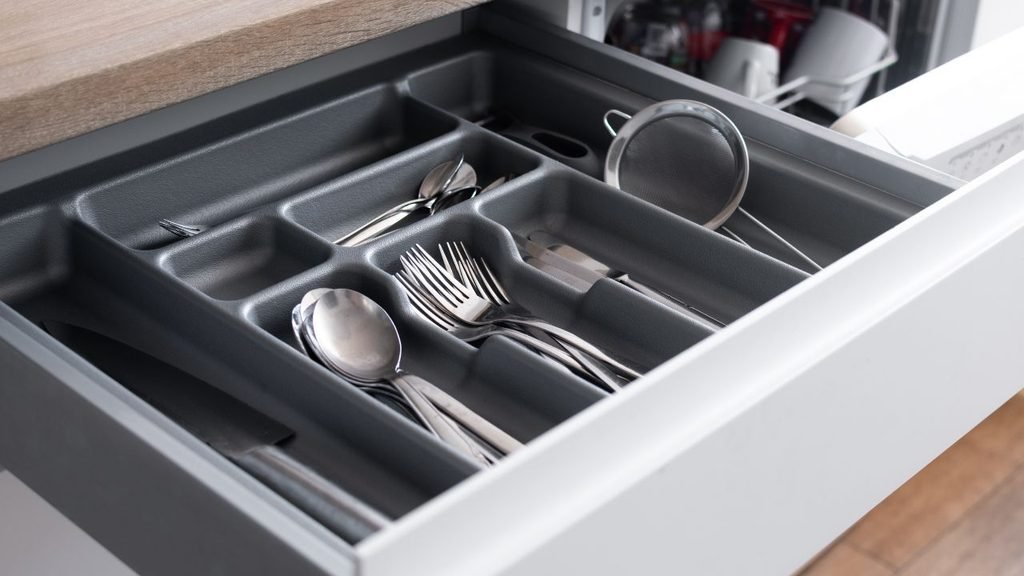
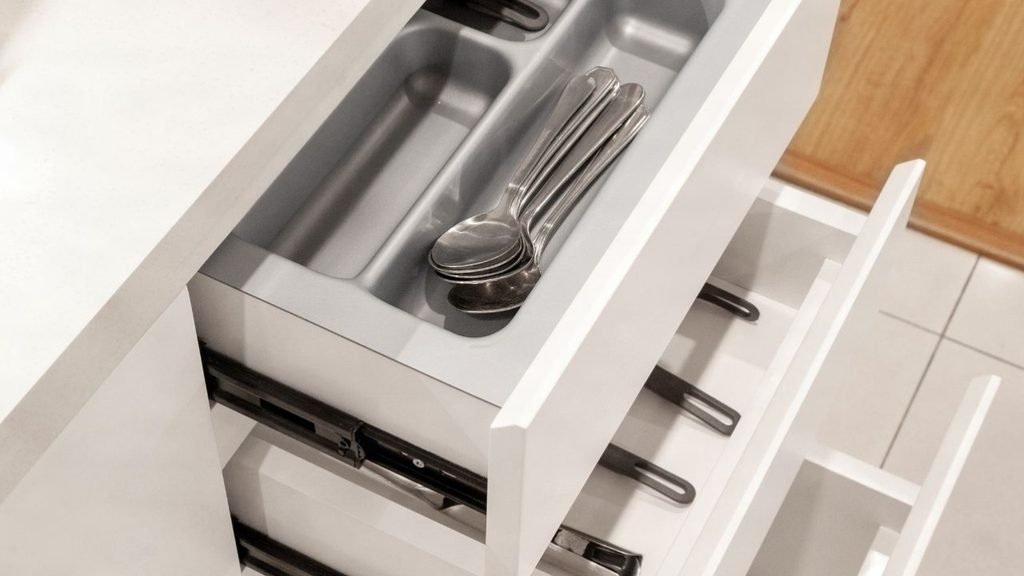
Choose a divided tray with one slot per type: forks, knives, spoons, teaspoons. Plastic and bamboo both work. Trays with small feet also protect the drawer base from scratches.
The Utensil Drawer
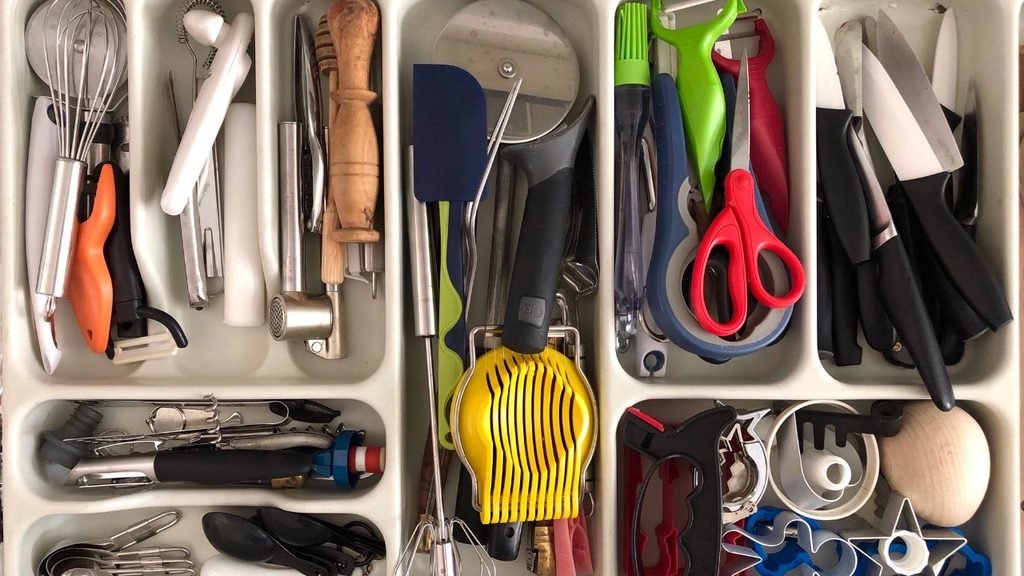
Angled or adjustable dividers fit bulky tools like ladles and whisks better than fixed compartments. Expandable dividers let you build a custom pocket around awkward shapes, so you aren’t hunting for the perfect-size tray.
The Knife Drawer
A knife tray or in-drawer block keeps blades covered, and it also protects your fingers during a blind reach. One home blogger who hesitated over giving up space for a drawer knife block said she wished she’d done it sooner.
The Baking Drawer
Group by task, not by size. Measuring cups and spoons go together, then cutters and spatulas. Modular bins let you reshuffle the layout when your baking habits change. A deep drawer under a wall oven can serve as a complete baking station, as one professional organizer did for a client with a baking business.
The Spice Drawer
A slotted spice rack lets jars lie flat with labels facing up. Arrange them alphabetically and add labels, and finding cumin takes two seconds instead of two minutes.
The Junk Drawer
Every household needs one. Pens, scissors, batteries and keys need a home, and a divided tray in a low-traffic spot gives them one. The key is leaving no empty space for stray objects to pile up.
The Container Drawer
Stand lids in vertical dividers and stack container bottoms on the other side, ordered by height. This one change ends the Tupperware avalanche.
Kitchen Drawer Organization for Deep Drawers
Deep drawers hold a lot and hide even more. Items sink, stacks tip, and whatever you need lives at the bottom. The fix is to give height a job.
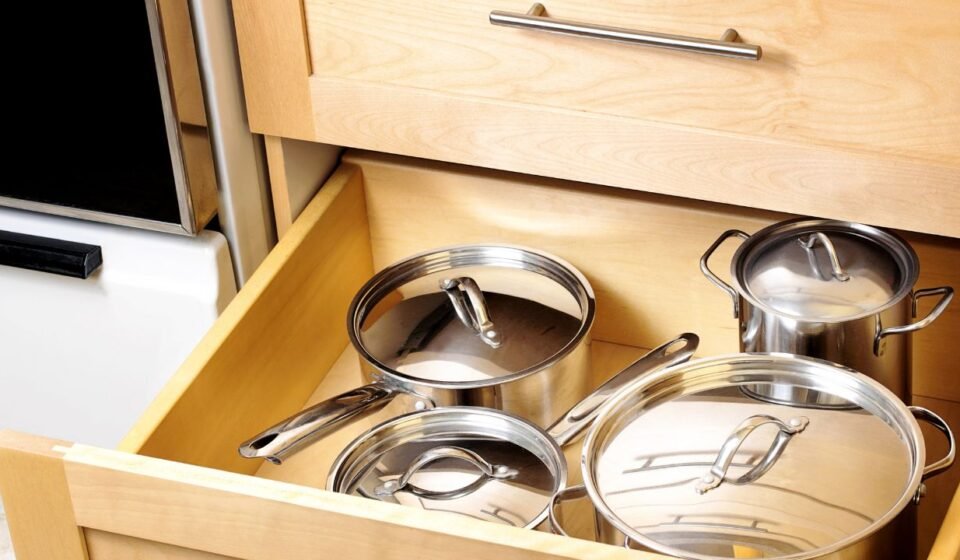
Divide the space. Adjustable dividers suit pots, pans and food containers. Expandable wood or plastic dividers are an easy DIY upgrade. For a custom look, thin plywood pieces can be cut into cubbies sized to your cookware.
Handle lids separately. Stack lids vertically along one side of the drawer, separated by tension rods. Slim inner drawers above the pots also work well, if your cabinetry allows.
Know when you don’t need organizers. One cabinet maker notes that deep drawers hold up well without inserts when you own ten or fewer pieces of cookware, as long as lids are stored separately.
Go two-tier in mid-depth drawers. For a drawer 11 or 12 inches tall, a two-level approach works. Standard drawer boxes around 4 inches deep can also take a tiered insert, adding a second layer of storage.
Protect and quiet the drawer. A liner on the bottom cuts noise and prevents scratches on cookware.
Check your sizes. If you own a tall stockpot or a pressure canner, drawers around 24 inches deep fit them more comfortably. One cabinet-design source notes that IKEA deep drawers max out around 20 inches, so an oversized stockpot may not lie flat there.
A common base-cabinet layout uses three drawers of graduated heights: shallow on top for utensils, medium in the middle for smaller pans, deep at the bottom for stockpots. If you’re building new, ask for that stack beside the range.
Kitchen Drawer Organization IKEA Style (Canada Sizes and Prices)
Shoppers comparing kitchen drawer organization IKEA options will meet the UPPDATERA line, and the Canadian site sorts it by cabinet width. IKEA Canada lists trays for 24″ and 30″ kitchen drawers, which covers most kitchen drawer organization Canada setups. The inserts are designed to fit any kitchen drawer, so you don’t need an IKEA kitchen to use them.
What stands out in the range:
- Adjustable organizer (24×24″): you cut and rearrange the dividers to match what you store. It was listed at CAD $14.99 at the time of research.
- Pegboard organizer (30″): listed at $16.99 on IKEA Canada, with the 24″ size $2 cheaper. One review of the pegboard highlighted its roughly 20-by-25-inch board and 32 movable pegs for pots, pans and plates.
- Sliding organizer (23 5/8″): creates extra storage for spice jars, rolls and utensils, and the soft material dampens sound.
- Cutlery, utensil and knife trays: available in white plastic and light or dark bamboo.
- Boxes and drawer mats: boxes sort small items, and a mat grips the base of the drawer.
Prices and stock change often, so confirm them on the IKEA Canada page before you buy.
Metric versus imperial. Canadian cabinets are commonly sized in inches, while IKEA lists centimetres first. Use the conversion in parentheses and match against your own measurements, not the cabinet’s nominal size.
Kitchen Cabinet Drawer Organization: Make Cabinets and Drawers Work Together
Treat drawers and cabinets as one system. A kitchen cabinet drawer organization plan assigns heavy, bulky items to deep base drawers, small daily tools to top drawers, and rarely used items to upper cabinets. A few combos that pay off:
- Base cabinet beside the stove: a three-drawer stack for utensils, lids and pans.
- Pull-out cabinet shelves: an alternative where a drawer front isn’t an option.
- Shelf inserts: IKEA’s VARIERA shelf insert adds a second level inside a cabinet.
- Toe-kick drawers: shallow drawers at the base can hold cookie sheets and muffin tins.
When cabinet space runs out, borrow from drawers, and the other way round. A kitchen is a trade-off between volume and reach, and the best layouts keep the daily 20 percent within an arm’s length.
Kitchen Drawer Organization Cleaning Organizer Setup
Cleaning supplies deserve a plan, particularly under the sink, where bottles tip and sponges multiply. A kitchen drawer organization cleaning organizer setup that works:
- Grip the base. A non-slip drawer mat stops bottles from rolling. IKEA Canada sells a 50×79 cm UPPDATERA mat you can trim to fit.
- Contain the small stuff. Use small boxes for sponges, cloths and gloves.
- Pull it out. IKEA also lists a UTRUSTA pull-out rack for cleaning supplies, 140 cm wide.
- Group by task. Dishes, counters and floors each get a zone.
- Think safety. Keep chemicals in a closed container, higher up or locked if children or pets share the home.
Drawer-by-Drawer Cheat Sheet
| Drawer | Best insert | Quick rule |
|---|---|---|
| Cutlery | Divided tray | One slot per type |
| Utensils | Adjustable dividers | Keep only what you use weekly |
| Knives | Knife tray or in-drawer block | Blades never loose |
| Baking | Modular bins | Group by task, not size |
| Spices | Slotted rack | Labels facing up |
| Pots and pans | Pegboard or deep dividers | Heavy items at the bottom |
| Containers | Vertical dividers | Every lid has a partner |
| Cleaning | Mat plus small boxes | Chemicals closed and secure |
| Junk | Small divided tray | Set a limit, then stick to it |
Common Mistakes (and Quick Fixes)
- Buying before measuring. Returns pile up fast. Measure first, sketch second, shop third.
- Organizing everything the same way. A utensil drawer and a baking drawer have different needs.
- Overstuffing. Leave breathing room. A packed deep drawer defeats its purpose.
- Skipping labels. Even a strip of tape helps when several people unload the dishwasher.
- Treating it as a one-time project. Put strays back, and give each drawer a 10-minute review every season.
Your 2-Hour Drawer Reset Plan
- Minutes 0 to 15: measure every drawer and note the sizes.
- Minutes 15 to 45: empty and sort the first three drawers.
- Minutes 45 to 75: wipe, line and place dividers or trays.
- Minutes 75 to 105: return items by zone, daily tools at the front.
- Minutes 105 to 120: label, then walk through a pretend dinner and adjust.
The “pretend dinner” matters. Open each drawer as if cooking, and any awkward reach shows up right away.
Frequently Asked Questions
What is the best way to organize kitchen drawers?
Declutter first, map zones by where you use each item, then add dividers sized to the drawer.
How do I organize very deep kitchen drawers?
Stand items upright in dividers, add a tiered insert, use a pegboard for plates and pans, and keep lids on one side with tension rods.
Do IKEA drawer organizers fit non-IKEA drawers?
Yes. IKEA states that the UPPDATERA series suits any drawer, even in kitchens that aren’t from IKEA. Measure the interior first.
How much do kitchen drawer organizers cost in Canada?
At the time of research, IKEA Canada listed adjustable organizers around $14.99 and pegboard organizers around $16.99. Check current prices.
How often should drawers be reorganized?
A full reset once a year is enough, with a quick seasonal tidy in between.
Final Thoughts: Drawers That Do Their Job
Strong kitchen drawer organization comes down to three moves: remove what you don’t need, group what stays by how you cook, and give every group a fixed home. A $14.99 adjustable tray, a pegboard for the deep drawer or a set of bamboo dividers will all work, as long as they fit the drawer and the habit. Next time the pasta water starts to boil, the wooden spoon will be exactly where your hand expects it.